Secretario Íntimo
Grado VI

Grado VI
Segunda Clase – Tercero Capitular
La alegoría de este grado Israelita-Salomónico, confusa y oscura como es, no permite definir claramente su significado; tiende, al parecer, a la recompensa de la fidelidad, aunque ésta llegue a traspasar los límites de la prudencia o del deber.
El ritual está basado en el episodio del celo demostrado por uno de los secretarios favoritos de Salomón, que se detuvo a escuchar, oculto detrás de una puerta, la polémica que éste sostuvo con Hiram, rey de Tiro, y que creyendo que éste amenazaba a su señor, corrió en su auxilio, descubriendo su curiosidad, por lo que Hiram quería darle muerte en el acto.
Pero, apreciándolo Salomón como un acto de celo y de fidelidad, no solo se opuso a ello, sino que aun le recompensó, colmándole de favores y nombrándole su Secretario Íntimo.
El eje simbólico de este grado son los dos reyes: Salomón e Hiram de Tiro.
Su meditación es la armonía de los contrarios. Coincidentia oppositorum.
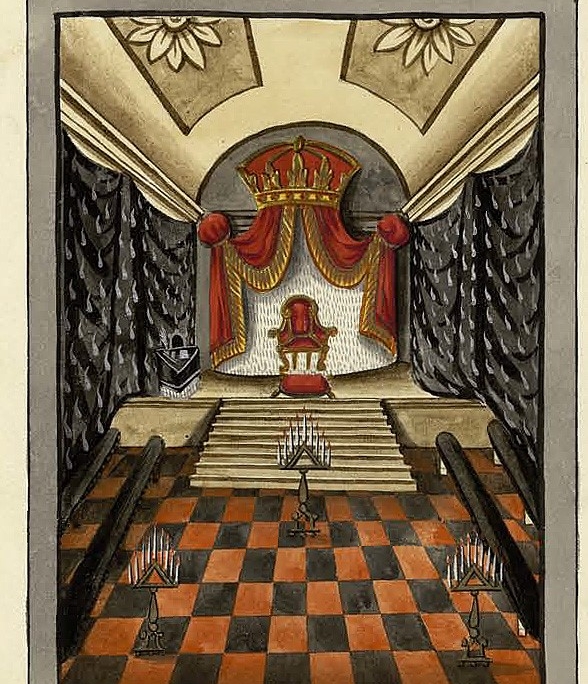
La decoración de la Logia es con tapicería negra sembrada de lágrimas blancas: veintisiete luces distribuidas en tres candeleros de nueve brazos.
SIXTH DEGREE. INTIMATE SECRETARY.
The sixth cleffree, or third of Perfection, is called Intimate Secretary. The traditional history refers to a meeting which took place at Jerusalem between King Solomon and Hiram, King of Tyre, relative to some cities in Galilee which the former proposed to give the latter in exchange for cedar- wood from Lebanon, and other materials for the Temple.
There are three officers in the degree, representing the two kings already mentioned, and a captain of the guard. The Lodge represents an audience-hall, hung Avith black, sprinkled with white; lighted by twenty-seven lights in three candelabras of nine branches each.
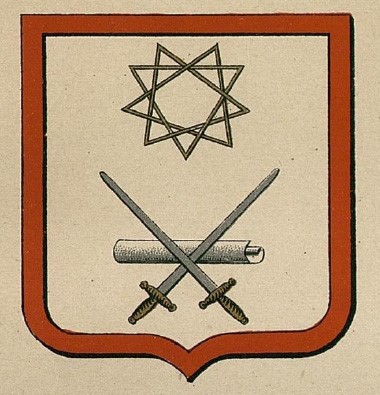
The apron is white, bordered with red ; there is a triangle on the flap. The jewel, which consists of three interlaced triangles, is susjjended from a red watered ribbon. Gloves of white, bordered with red, are worn. The two principal otiice-bearers wear blue robes, bordered with ermine and crowns. There is a table on which crossed swords and a roll of papers are placed.
Loth, J. (1875). The ancient and accepted scottish rite Ilustrations of the emblems of the thirty – three degrees. Simpkin, Marschall, & Co. https://archive.org/details/cu31924030318541